When NOT to Build a Multi-Agent AI System (And What to Do Instead)
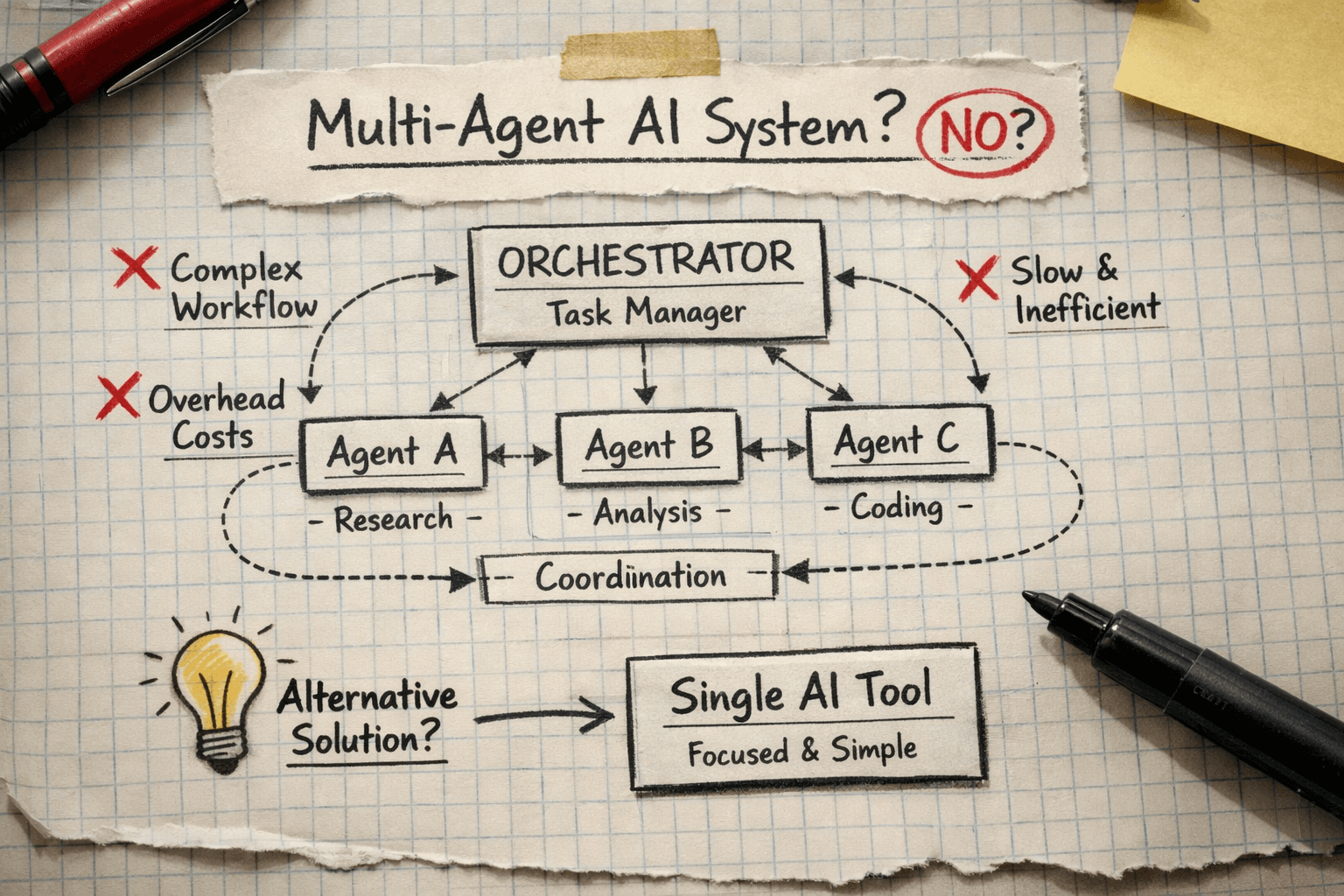
The system had six agents. An orchestrator, three specialized document processors, a validation layer, and a synthesis agent. LangGraph workflows, typed state channels, structured handoffs between every step. It took three months to build and another month to stabilize. In production, it failed on 19% of requests, averaged 11 seconds per run, and consumed three times the token budget the team had estimated.
The worst part wasn't the latency or the failure rate. It was what a retrospective audit of the input data revealed: 71% of documents were single-policy lookups that one well-prompted agent — with access to the right retrieval tools — could have resolved in under a second.
The architecture was impressive. It was also the wrong architecture for the problem.
What a Multi-Agent AI System Actually Is — And Why Everyone Is Building One
A multi-agent AI system is an architecture where two or more LLM-powered agents divide a workflow by role — one retrieves, another reasons, another validates — coordinated through a central orchestrator or structured peer handoffs. It works by decomposing a complex task into subtasks that agents handle independently or in parallel, then merging their outputs into a final result. Unlike a single-agent system, which consolidates all reasoning and tool use within one context and execution loop, a multi-agent system trades coordination complexity for parallelism and specialization.
The appeal is real. The problem is that "when to use multi-agent AI" has become the wrong question. The default has shifted from "do we need this?" to "which multi-agent framework should we use?" — and that inversion is expensive.
Gartner put a number on it in June 2025: over 40% of agentic AI projects will be canceled by the end of 2027, citing escalating costs, unclear business value, and inadequate risk controls. Anushree Verma, Senior Director Analyst at Gartner, was direct: "Many use cases positioned as agentic today don't require agentic implementations." That's not a critique of the technology — it's a critique of how teams are applying it. Gartner also estimates that of the thousands of vendors currently claiming agentic capabilities, only about 130 are genuine — the rest are rebranding existing chatbots and RPA tools.
The rise of capable frameworks like LangGraph, CrewAI, and the OpenAI Agents SDK has made multi-agent systems genuinely easier to build. But easier to build doesn't mean appropriate to build. If you're still evaluating whether agentic architecture belongs in your stack at all, our overview of agentic AI for enterprises covers the foundational tradeoffs before you get to architecture decisions.
The Misconception: More Agents Means a Smarter System
The intuition seems sound. Complex problems need specialized expertise. Specialization requires separation. Separation means agents. So: complex problem → multi-agent. This logic fails — and recent research has quantified exactly how badly.
In December 2025, Yubin Kim and colleagues from Google Research and MIT published "Towards a Science of Scaling Agent Systems" (arXiv:2512.08296), a controlled study of 180 configurations across five agent architectures and three LLM families. The finding that should change how teams approach this: independent multi-agent networks — agents working in parallel without structured coordination — amplified errors 17.2x compared to single-agent baselines. Not 17% worse. Seventeen times worse. Centralized coordination (an orchestrator checking agent outputs before passing them downstream) contained that amplification to 4.4x.
The mechanism isn't complicated. When agents operate without a validation bottleneck, each agent's output becomes the next agent's input unchecked. Errors don't cancel. They compound. A document agent misreads an ambiguous clause. The analysis agent reasons confidently from that misread. The synthesis agent produces a polished summary of a wrong conclusion. By the time a human sees the output, the original error is three layers deep in confident LLM prose.
The same study found a capability saturation threshold: when a single-agent baseline already exceeds approximately 45% accuracy on a given task, adding agents yields diminishing or negative returns. Below that threshold, decomposition and coordination can genuinely help. Above it, you're adding engineering overhead without adding capability. And for sequential reasoning tasks specifically — the kind that many enterprise workflows actually require — every multi-agent variant degraded performance by 39–70% compared to single-agent.
Anthropic's engineering team arrived at a compatible conclusion from production experience. Their "Building Effective Agents" guide recommends starting with the simplest solution possible and increasing complexity only when simpler approaches demonstrably fail. That's not conservatism — it's what shipping reliable systems looks like in practice.
Four Conditions That Actually Justify Multi-Agent Architecture
When does multi-agent architecture make sense? There are four conditions worth treating as genuine justifications — and each comes with a counter-signal that reveals when the condition doesn't actually apply.
The task is genuinely parallelizable. Subtasks are independent, can run simultaneously, and their outputs can be cleanly merged without requiring shared intermediate state. Financial document analysis is a real example: one agent pulls market data, another analyzes company fundamentals, a third reviews filings — all against separate data sources, producing outputs that merge cleanly at the end. The counter-signal is any workflow where step B depends on the specific output of step A, rather than external data. That's sequential reasoning, and the DeepMind study shows multi-agent architectures degrade performance there by up to 70%.
Security or compliance requires separation of duties. Financial services workflows — where transaction preparation and transaction validation must be handled by independent processes — are the clearest case. The architecture enforces a control boundary that a single agent with access to both functions can't provide. For the kind of document intelligence and claims automation we've done in AI medical claims processing, this constraint was genuine and drove the decision. The counter-signal: if your context doesn't actually mandate audit separation, you're borrowing complexity from a compliance problem you don't have.
Domain expertise requires context isolation. A single prompt with 12 tools, 3,000 tokens of instructions, and a dense system prompt taxes model attention in ways that matter. When a specialized agent operates with a narrow context — only the tools and instructions relevant to its domain — it often reasons more accurately on that domain. The counter-signal: if your "specialized" agent still needs most of the same context as the general agent to perform its task, the separation is cosmetic.
Fault isolation is a production requirement. When one component of a workflow needs to be independently retried, replaced, or version-controlled without cascading changes, multi-agent architecture provides genuine operational value. The counter-signal: if a failure in any one agent invalidates the whole workflow's output anyway, you don't have fault isolation — you have a failure mode that compounds silently instead of failing loudly.
These conditions aren't additive. One strong condition is enough to justify the architecture. Zero conditions means a well-designed single agent with the right tools is almost certainly the better choice. LangGraph is worth reaching for when you genuinely hit one of these conditions — its explicit state management and human-in-the-loop checkpoints make centralized coordination tractable in production. Below the threshold, it's overhead without benefit.
The Coordination Tax: A Named Failure Mode
There's a failure pattern worth naming: the Coordination Tax — the point where adding agents increases cost, latency, and error rate faster than it increases capability. Most teams hit it without naming it, and without naming it, they can't fix it.
The math is unforgiving. A single agent completing each step at 95% reliability sounds acceptable. Chain five steps: 0.95⁵ = 77.4% end-to-end success rate. Chain ten: 0.95¹⁰ = 59.9%. Drop per-step reliability to 90% — not unreasonable for complex tasks with ambiguous inputs — and a ten-step pipeline succeeds only 34.9% of the time. Every agent you add to a sequential workflow is another compounding factor in that arithmetic. Your architecture document doesn't mention this. Your token cost estimates don't mention this. The failures show up in production, not in demos.
Diptamay Sanyal, Principal Engineer at CrowdStrike, observed this pattern while building an AI agent platform at a previous role. Speaking to CIO magazine in 2026, he described the practical reality: single agents working on discrete, well-scoped tasks perform reliably, but true multi-agent collaboration fails frequently. The systems that appeared to be multi-agent from the outside — and actually worked — were architecturally sequential specialization with deterministic handoffs. "The real value of AI agents today is automating repetitive, well-defined tasks at scale," he said. "Not emergent collective intelligence."
The Multi-Agent Systems Failure Taxonomy study (MAST, March 2025) analyzed 1,642 execution traces across seven open-source agent frameworks. Failure rates ranged from 41% to 86.7% across frameworks. The largest failure category: coordination breakdowns, at 36.9% of all observed failures. Not hallucinations. Not tool errors. Coordination. That's where multi-agent goes from ambitious to overkill — when the coordination layer requires more engineering maintenance than the agents themselves.
How We Decided: The CoverWise Architecture
CoverWise, an insurance technology company, needed an AI system to process policy documents: extract key terms, cross-reference against regulatory requirements, and route discrepancies for human review. The initial architecture proposal on the table was a four-agent pipeline — extraction, normalization, compliance checking, and review routing.
Before writing a line of orchestration code, we ran a single-agent baseline. One agent, the extraction and retrieval tools, the compliance ruleset in context. We measured accuracy on 200 representative documents against the agreed acceptance threshold.
The baseline handled 74% of documents correctly. For that majority, a multi-agent pipeline would have added latency, token cost, and coordination complexity with no measurable quality gain. The 26% that genuinely required multi-step cross-referencing — policies with complex cross-jurisdiction requirements where the compliance ruleset couldn't fit in a single context window alongside the document — were the ones that justified a second agent. We added exactly one: a specialized compliance agent that activated only for documents the first agent flagged with low confidence.
The resulting system processed 74% of volume with single-agent speed and cost. The remaining 26% routed to a two-agent workflow with appropriate latency expectations set upfront. Production failure rate was 3.1%. The baseline measurement is what made this possible — it told us where the architecture actually needed to be more complex, rather than where it felt like it should be. The context engineering decisions that made the single-agent baseline perform well at that accuracy level are worth understanding before you design any agent architecture.
Before You Add a Second Agent, Run These Checks
The decision to add a second agent should be forced by evidence, not anticipated by instinct.
Measure your single-agent baseline first. Before any orchestration work, run a representative sample through one agent with access to the relevant tools. If your baseline accuracy already exceeds ~45% on the task — the saturation threshold from the DeepMind study — adding agents is unlikely to help significantly. The model is already capable. What you probably need is better context management, not more coordination.
Define in one sentence what the second agent does that the first can't. If you can't write that sentence clearly, you're not ready. "It specializes in compliance" is a category, not a definition. "It cross-references extracted terms against regulatory lookup tables that would overflow the first agent's context window" is a definition. The sentence test is ruthless and useful.
Design the handoff schema before you write agent logic. What structured data passes between agents? What type contract does the receiving agent expect? What happens when the incoming payload is malformed? This is what breaks in production — not the agent logic itself, but the interface between agents. Build and validate the schema independently first.
Set your reliability budget before you build. Decide what end-to-end success rate is acceptable, then work backwards through the compound reliability math. If you need 95% end-to-end reliability and each agent step runs at 97%, you can chain at most six steps before you breach that budget. That arithmetic should constrain your architecture before you write it — not explain your production failures after the fact.
Instrument observability from the start, not after. Every tool call, every handoff, every state transition should be traced before you ship. In LangGraph, this means logging state at every node. Without traces, coordination failures — the dominant failure mode in multi-agent systems — are functionally invisible until they cascade.
If you're working through these decisions for a specific system and want a second opinion from engineers who've shipped agentic systems in production, Artinoid's AI Engineering practice is a practical place to start that conversation.
Multi-Agent Is a Destination, Not a Default
The teams that ship reliable agentic systems aren't the ones who started with the most sophisticated architecture. They're the ones who started simple, measured what their baseline could actually do, and added complexity only when the data demanded it.
Multi-agent AI is a powerful architectural pattern — for the right problems. The right problems are parallelizable, cross-domain, context-constrained, or compliance-bounded. Most enterprise AI problems aren't all of those things. Most are one or two of them, if any. And most can be solved with a well-designed single agent and honest baseline measurement before anyone opens a LangGraph tutorial.
Gartner's 40% cancellation prediction isn't a forecast about bad technology. It's a forecast about architectural decisions made too early, at too large a scale, with too little baseline data. The teams in that 40% aren't building bad systems. They're building the right systems for the wrong problems — and spending months finding out.
Build the single agent. Measure it honestly. Let the data tell you when it's not enough.
If you're making this decision for a live system and want engineers who've been through it, start here.