Building an AI Assistant That Finally Makes Insurance Policies Readable
CoverWise is an AI-powered document intelligence system that reads insurance policies the way a human expert would, but responds in seconds.
 Python
 FastAPI
 Next.js
 React
React TypeScript
 LangChain
 OpenAI Embeddings
 Anthropic Claude
 ChromaDB
 Tailwind CSSRAG
Insurance policies are not written for humans. They are written for compliance.
Most people only open their policy document when something goes wrong. At that moment, they are faced with 50 to 100 pages of dense legal language, cross-referenced clauses, and layered exclusions. What should be a simple question turns into a frustrating search.
"Am I covered if my car is stolen from a parking lot?"
The answer exists. But it is scattered across definitions, coverage sections, exclusions, and conditions that refer to each other. Even experienced support agents take time to piece it together.
We built CoverWise to solve exactly this problem.
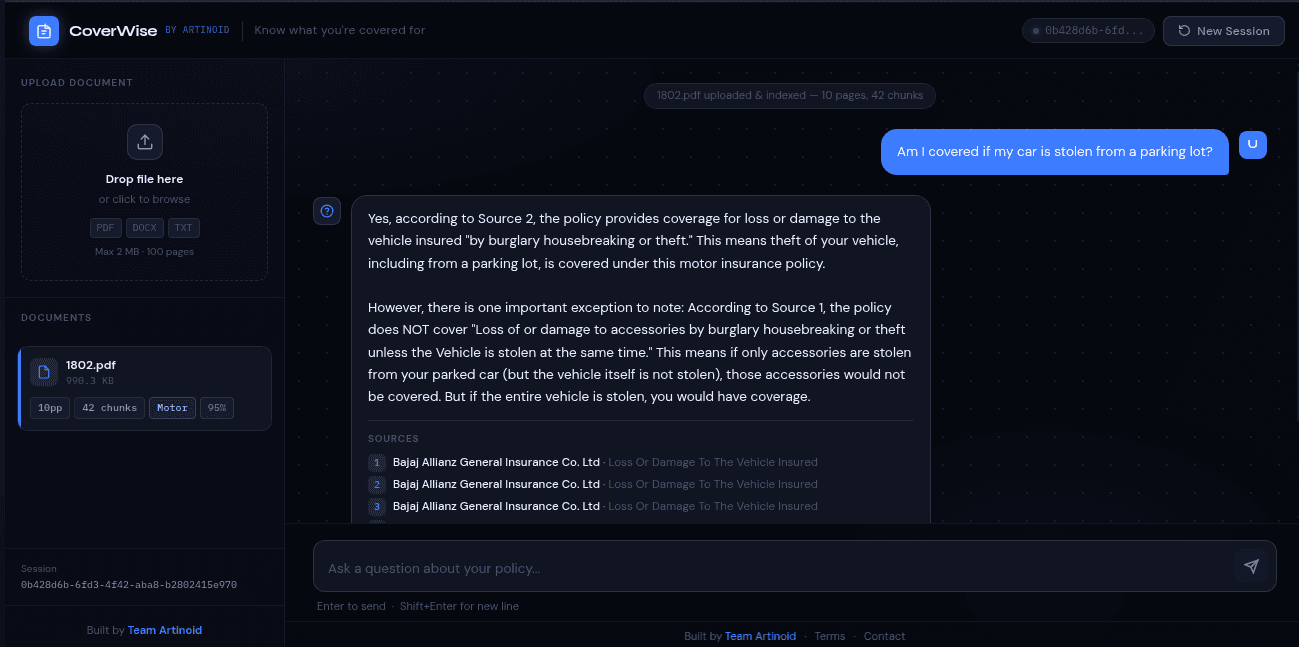
The Outcome
The Problem We Set Out to Solve
Traditional approaches fail in two major ways.
Keyword search is too shallow
Searching for a term like "theft" returns dozens of matches. Definitions, exclusions, limits, and claim procedures all appear together with no context. Users still have to read and interpret everything themselves.
Generic AI chatbots are unreliable
Out-of-the-box AI systems tend to hallucinate. They generate answers that sound correct but are not actually supported by the document. In a domain like insurance, this is not just a bad experience. It creates real risk.
We needed a system that would:
* Answer strictly from the document
* Show exactly where the answer comes from
* Admit when the document does not contain enough information
What We Built
CoverWise is a full-stack RAG (Retrieval-Augmented Generation) system built with a Python and FastAPI backend and a Next.js frontend. But the real innovation lies in how it understands and retrieves information from complex documents.
1. Understanding the Document Before Answering
Most document AI systems start by splitting text into chunks and indexing them.
We took a different approach.
When a policy is uploaded, CoverWise first analyzes its structure. It identifies:
* Policy type such as Motor, Home, Health, or Travel
* Section boundaries using deterministic parsing and heuristics
* Section categories like Coverage, Exclusions, Claims Process, Definitions, and Terms
By doing this upfront, the system builds a mental model of the document. It does not just store text. It understands how the document is organized.
2. Parent-Child Chunking for Context and Precision
One of the key challenges in RAG systems is balancing context and precision.
If chunks are too small, the model misses important context.
If chunks are too large, retrieval becomes noisy.
CoverWise solves this with a two-level chunking strategy:
* Parent chunks represent full sections with all related clauses
* Child chunks represent individual clauses or statements
Each chunk carries metadata such as section type, titles, page numbers, and relationships.
This allows the system to retrieve answers that are both precise and contextually complete.
3. Intent-Aware Retrieval
Not all questions are equal.
A question about deductibles is very different from a question about exclusions or claims.
Before searching the document, CoverWise classifies the user's intent. It determines whether the query relates to:
* Coverage
* Exclusions
* Claims
* Definitions
* Terms and conditions
This classification step narrows down the search space before semantic retrieval even begins. As a result, the system avoids irrelevant matches and improves answer quality significantly.
4. Grounded Answers with Citations and Confidence
Answer generation is powered by Anthropic's Claude, but with strict constraints.
The model is only allowed to use retrieved context from the policy. It cannot rely on general knowledge.
Every response includes:
* Inline citations with page numbers and section references
* A confidence score between 0 and 1
The confidence score reflects how strongly the retrieved content supports the answer.
* A high score means the answer is explicitly stated
* A lower score indicates partial or incomplete information
If the document does not contain the answer, the system says so clearly.
This builds trust, which is critical in insurance.
5. Designed for Real-World Use
We deliberately optimized the system for practical deployment.
* Minimal LLM calls during document ingestion
* Efficient retrieval pipeline for fast responses
* Scalable architecture that can handle large policy documents
The result is a system that feels responsive, reliable, and usable in real customer scenarios.
Why This Matters
CoverWise changes how people interact with complex documents.
Instead of reading policies line by line, users can ask questions and get answers that are:
* Immediate
* Verifiable
* Easy to understand
For businesses, this means fewer support queries and faster resolution times.
For users, it means clarity during moments that actually matter.
Live Demo
You can explore CoverWise here: cover-wise.artinoid.com
Need an AI-Powered Document Intelligence Solution?
From RAG pipelines to production AI systems, we build intelligent applications that understand your documents and deliver real answers — not hallucinations.
Get in Touch