The True Cost of an AI Project in 2026: What Vendors Don't Tell You Until Month 3
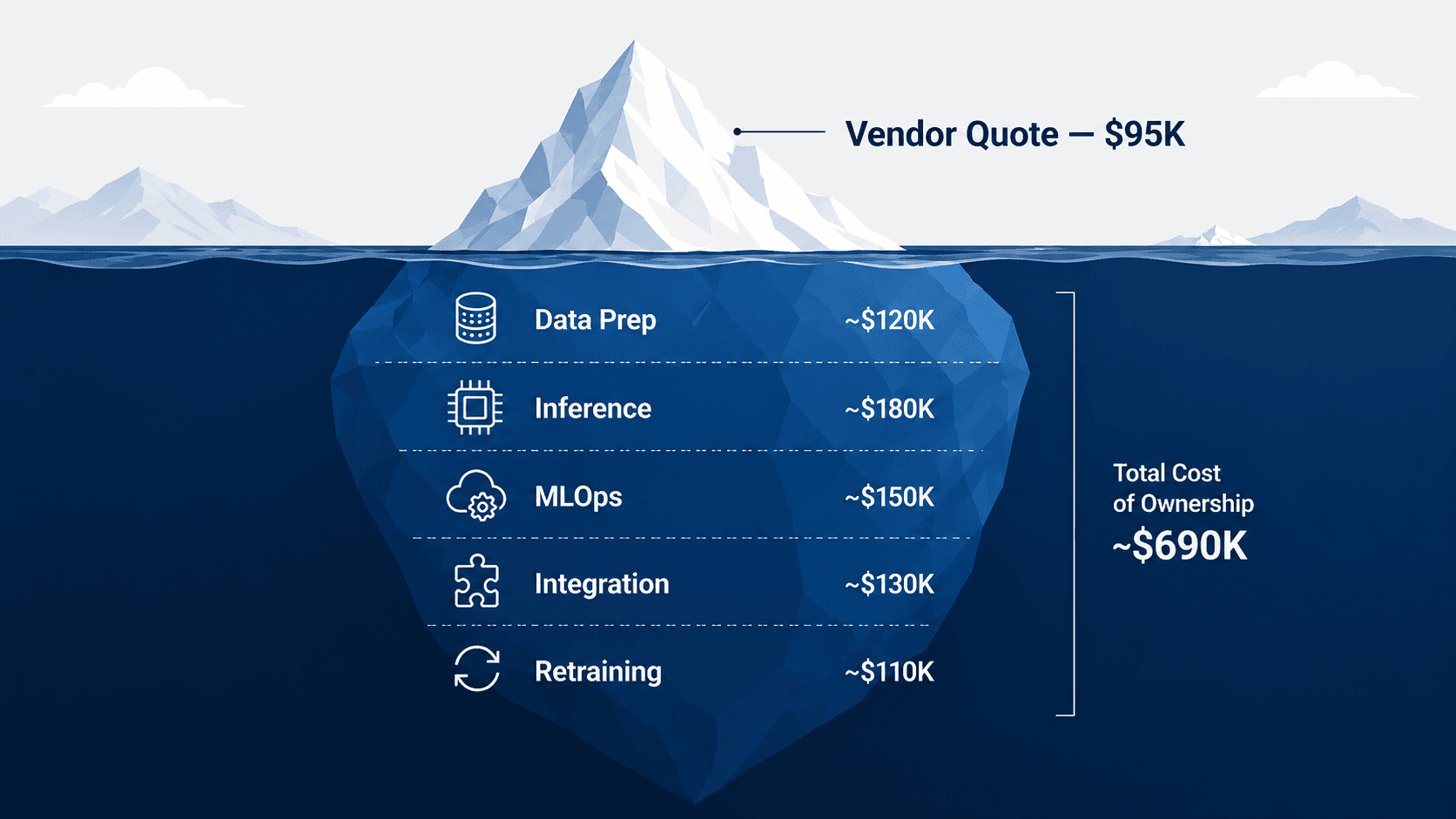
The contract was signed in January. The vendor quote was $140,000 — model development, integration, deployment. Reasonable for a production LLM system. By March, the team had shipped a working demo. Leadership was happy.
Then the cloud bill arrived.
$23,000 for the month. Not for training — for inference. The RAG pipeline was calling a frontier LLM for every document query, and nobody had modeled what 15,000 daily requests at peak would actually cost. The integration with the legacy CRM required three additional engineers and six weeks nobody had budgeted. The data pipeline, described in the proposal as "straightforward," revealed seven years of customer records spread across four incompatible schemas.
The project didn't fail. Year 1 cost $340,000, not $140,000.
What "AI Project Cost" Actually Means in 2026
AI project cost is the full lifecycle of expenses required to build, deploy, and operate an AI system at production scale. It includes data preparation, model integration, LLM inference at production volume, MLOps infrastructure for monitoring and retraining, legacy system integration, and the ongoing operational burden after launch. Quoting only model development — which is what most vendors do — is like quoting a house by the cost of lumber.
Gartner's research makes the stakes plain: only 48% of AI projects make it to production, and for those that do, the average time from prototype to deployment is eight months. That eight-month gap is where the real costs live, and most of them don't appear in the initial proposal.
John-David Lovelock, Distinguished VP Analyst at Gartner, framed the current moment precisely: "AI adoption is fundamentally shaped by the readiness of both human capital and organizational processes, not merely by financial investment." Gartner characterized enterprise AI in 2026 as being in the "Trough of Disillusionment" — a phase where early expectations outran real results and buyers are now demanding predictable ROI before committing. That's the right instinct. The challenge is that most AI vendors aren't structured to deliver that predictability at the proposal stage.
Understanding how AI projects move from pilot to production — and what breaks during that transition — is the prerequisite conversation most teams skip.
Why Your Vendor Quote Is Technically Accurate and Completely Misleading
Most AI vendors quote model development costs. They're quoting the engineering team, the sprint cadence, the API integration, the demo environment. That scope is real and the intent is honest. What the quote excludes is everything that converts a working demo into a system that runs reliably at scale.
The gap isn't a vendor ethics problem — it's a structural misalignment in how AI projects are bought and sold. When you ask "how much will this cost?", you're asking a question about engineering effort. The real answer requires a question about total system cost of ownership. Those are different conversations, and the industry hasn't standardized on having them at the right time.
Three cost categories almost never appear in an initial proposal. Inference costs at production volume — per-token pricing looks negligible during development, compounding into real budget lines at scale. Data remediation — vendors assume your data is ready; it almost certainly isn't. Integration debt — connecting an AI system to a legacy CRM, ERP, or document repository is rarely a line item, but it almost always becomes a project.
Guido Appenzeller, Partner at Andreessen Horowitz, coined "LLMflation" to name a genuine market dynamic: for equivalent model performance, LLM inference costs are dropping 10x per year. That trend is real. But enterprise LLM spend still doubled in the first six months of 2025 (Menlo Ventures, 2025), because usage scales faster than per-token prices fall. The per-call cost shrinks; the monthly bill grows. Teams that don't model this upfront find it in their cloud statement at Month 3.
The Five Costs That Show Up After the Contract Is Signed
Understanding where AI development costs actually come from changes how you evaluate a proposal — and whether the number you're quoted is complete.
1. Data preparation and remediation (Month 1–2)
Data preparation is consistently the largest hidden cost in AI development and the most underestimated. Before any model runs usefully against your data, that data needs to be cleaned, structured, deduplicated, and — for supervised use cases — labeled. Across enterprise AI projects, data preparation consumes 40–60% of total project budget and 60–80% of total project time before any model development begins (ARDURA Consulting, Nerd Level Tech, 2026). IBM CEO Arvind Krishna has noted publicly that roughly 80% of the work in any AI project is collecting and preparing data, not building the model.
The proposal assumed your data was clean and structured. Your data lives across five internal systems, two of which predate REST APIs. Building reliable data pipelines that keep the AI grounded in accurate, current information isn't glamorous work — but it's the actual foundation, and it almost never fits neatly into an initial scope.
2. LLM inference at production volume (Month 3+)
Development happens at low request volumes. Production doesn't. A RAG architecture hitting a frontier LLM for every document query costs pennies per request in a sandbox. At 20,000 daily queries, those pennies become a significant monthly line item. At 500,000+ API calls per month, the difference between a $0.005/call model and a $0.0001/call model compounds to $29,400 per year — on a single feature (Azilen, 2026). Production inference for LLM-based applications can run $5,000–$50,000 per month depending on request volume, model tier, and architecture choices.
Teams that prototype with a frontier model and deploy without re-modeling the inference cost at volume are setting themselves up for the Month 3 shock.
3. Integration with legacy systems (Month 2–4)
Every enterprise has legacy. ERP systems from 2008. CRMs with custom schemas nobody documented. Document repositories that predate REST APIs. Connecting AI to these systems requires middleware, connectors, data refactoring, and often security reviews that weren't in the original scope. Complex enterprise integrations add $40,000–$150,000 to total project cost (RTS Labs, 2026), and the actual scope only becomes clear after an engineer touches the first endpoint. This "invisible integration layer" is one of the most expensive items in enterprise AI and is nearly always absent from early estimates.
4. MLOps infrastructure (Month 3–6)
MLOps — model monitoring, versioning, automated retraining pipelines, and drift detection — gets cut from initial scope more often than any other component. A model deployed without monitoring drifts silently: retrieval accuracy degrades, outputs worsen, and nobody notices until an audit or a customer complaint forces the issue. Retroactively building MLOps infrastructure adds 25–40% to initial deployment costs annually when approached reactively (ARDURA Consulting, 2026). Doing it upfront costs a fraction of that.
5. Model drift and retraining cycles (Month 6+)
AI models aren't static software. Customer behavior shifts, product catalogs evolve, regulations change. Budget 15–25% of your initial build cost per year for retraining and model governance — more in regulated industries where audit trails add additional overhead.
Added together, these hidden layers equal 30–50% of the initial project cost every year, on top of the build (Elsner, 2026). Not as an edge case — as a median outcome.
"Pilot Purgatory": Why Most AI Projects Never Ship
There's a specific failure mode so common it has a name. Pilot purgatory is the state a project enters when the proof of concept works well enough to keep investment alive, but isn't engineered correctly enough to justify the push to production. Projects in pilot purgatory don't fail dramatically. They consume resources indefinitely, waiting for production readiness that never quite arrives.
The research on this pattern is consistent across multiple independent studies. Gartner predicted in 2024 that 30% of GenAI projects would be abandoned after proof of concept by end of 2025; updated data puts the abandonment rate at 50%+ through 2026. MIT's Project NANDA, covering 300+ AI initiatives through practitioner interviews and structured surveys, found in July 2025 that 95% of organizations deploying generative AI saw zero measurable return on profit and loss — not low return, zero. RAND Corporation's 2025 analysis confirmed over 80% of AI projects fail to deliver intended business value, twice the failure rate of non-AI IT projects.
The mechanism is architectural. PoC code is written to validate a hypothesis in a demo environment. It has no error handling, no monitoring hooks, no scalability patterns, no security controls. When leadership approves production development, the engineering team inherits PoC code and attempts to harden it. The result: 60–80% of the production budget goes toward rewriting rather than building (Azilen, 2026). A project planned for eight weeks that stretches to sixteen doesn't just take twice as long — it costs 2–3x the original budget when compounding delays, team context-switching, and renegotiated scope are accounted for.
The most reliable way to avoid pilot purgatory is to design the path from pilot to production before the first line of PoC code is written — production architecture decisions made upfront cost far less than architectural debt discovered mid-build.
A Realistic Cost Breakdown: Mid-Market Document AI
Here's a concrete illustration — composite and representative of the pattern we see across production AI builds. A mid-market insurance company decides to build an AI system for policy document queries. Underwriters and customers need fast, accurate answers from complex policy documents. The use case is real. The ROI case is sound. Initial vendor proposal: $95,000.
Phase 1 — Proof of Concept (Weeks 1–6): $28,000. A RAG pipeline is built over a sample of 200 policy documents using a vector store and a frontier LLM. Retrieval accuracy looks strong in the demo environment. Leadership approves production. The challenges specific to insurance document AI — policy version conflicts, cross-document references, OCR-dependent scanned docs — haven't been encountered yet because the PoC data set was curated.
Phase 2 — Production Build (Months 2–5): $187,000. The team discovers the document archive spans three systems, two file formats, and includes a significant percentage of scanned PDFs that require OCR processing before they're embeddable. Inference costs, modeled against actual production query volume, come in at $14,000/month. Integration with the claims management platform takes six additional weeks. A compliance review adds two more.
Phase 3 — Year 1 Ongoing Operations: $96,000. Infrastructure, inference, monitoring tooling, and part-time MLOps support.
Total Year 1 actual cost: ~$311,000, against an initial quote of $95,000. Nothing went wrong in the conventional sense. The data complexity, integration scope, and inference volume simply weren't modeled upfront.
The pattern repeats across domains. For AI hiring platforms, the equivalent hidden costs come from resume schema variability and ATS integration complexity. For field sales AI, it's CRM data quality and real-time sync architecture. The surface details differ; the cost structure doesn't.
Five Questions to Ask Before Signing an AI Contract
The difference between a project that hits its budget and one that doubles isn't the technology — it's the conversation that happens before the contract is signed.
Ask what the data readiness assessment includes. Any proposal that doesn't begin with a structured data audit is quoting on assumptions. Request it as a deliverable before scope is finalized, not as a discovery phase mid-project.
Ask how inference costs are modeled at your production volume. Request a number: estimated daily requests × average tokens per request × model pricing = monthly inference cost projection. If the vendor can't provide this estimate, they haven't thought through production.
Ask what the production architecture looks like. A demo environment and a production environment are different systems. Ask for the MLOps setup, monitoring strategy, and rollback plan before work begins. Those three terms together reveal whether you're evaluating a team that builds systems or a team that builds demos.
Ask for the full integration scope. Every system the AI needs to read from or write to should be itemized in the proposal. "Integration complexity will be assessed during development" is a cost unknown that will surface mid-project at the worst possible time.
Ask what Year 2 costs. A vendor who hasn't thought about annual operations — retraining cycles, monitoring tooling, governance overhead — hasn't thought about the full product.
For teams who want to validate a use case against real data before committing to any of this scope, Artinoid's AI engineering practice runs structured POC engagements that produce a working prototype and a defensible production cost model — not a demo built on curated sample data.
Want a working prototype against your actual data in five days, before you commit a budget? That's what the Artinoid Free POC is designed for.
The Vendors Worth Trusting Show You the Iceberg Upfront
AI is in the Trough of Disillusionment in 2026. That's not a crisis — it's a correction. The projects that survive this phase are built on accurate cost models, production-grade architecture, and honest scope from day one. The ones that don't are the ones that looked inexpensive in January and became expensive by March.
The actual AI project cost isn't the number in the proposal. It's the inference bill at Month 3, the data pipeline that took twice as long as scoped, and the MLOps infrastructure you'll pay for either upfront or retroactively. Budget for the whole system, not just the visible tip.
The vendors who earn trust in this environment are the ones who surface the full cost picture before you sign — and the teams who get the best outcomes are the ones who demand it.
Start with a working prototype and a real cost model. Free, in five days. →