Why 90% of AI Projects Never Reach Production — and How to Avoid It
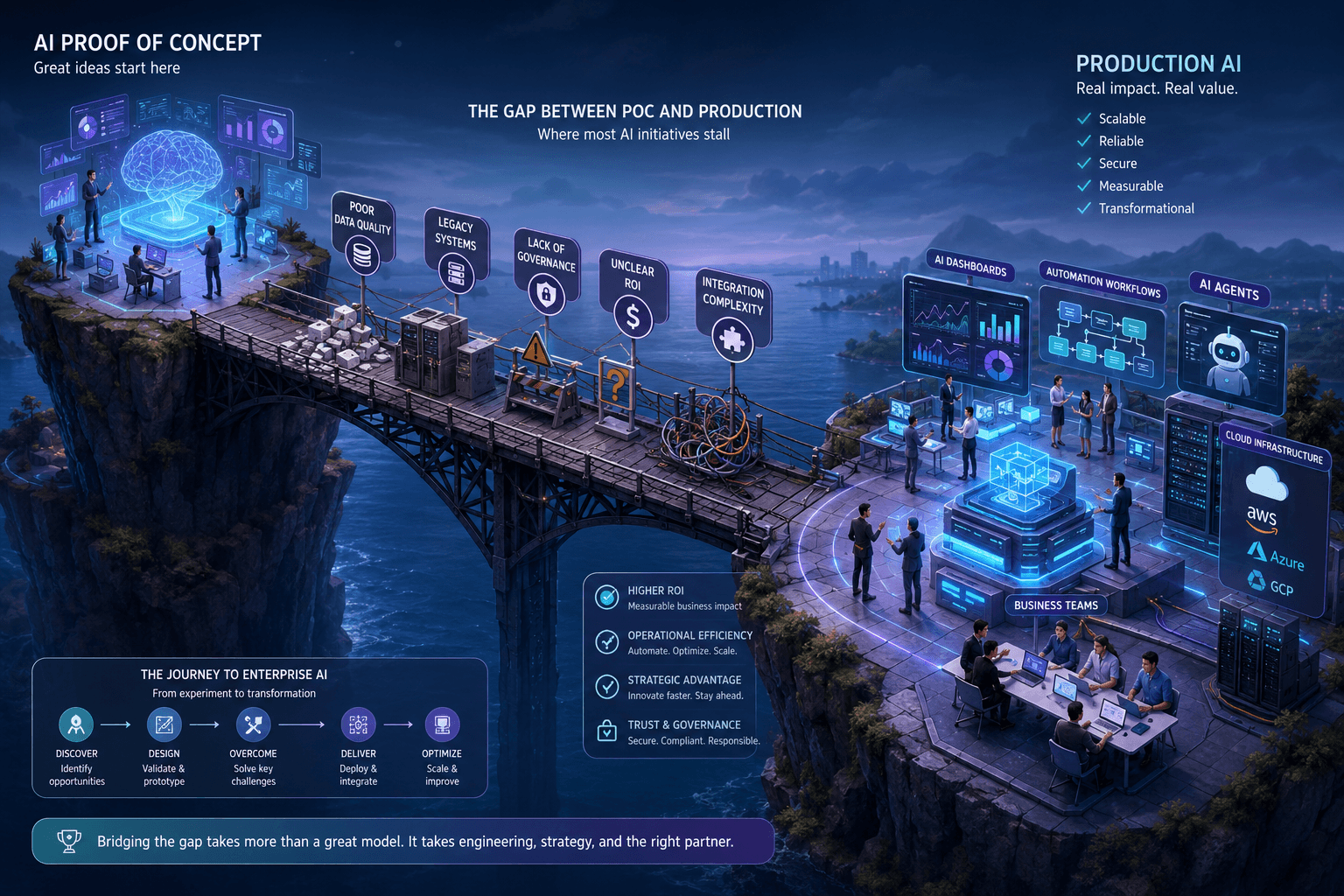
Artificial Intelligence has moved from experimentation to boardroom priority. Every CTO, founder, and technology leader wants to leverage AI to improve efficiency, automate workflows, and create competitive advantage.
Yet despite massive investments, the reality is sobering.
Industry studies consistently suggest that most AI initiatives never make it to production or fail to deliver meaningful business value after deployment.
The problem is rarely the AI model itself.
The real challenge lies in engineering execution, organizational readiness, data maturity, and long-term operationalization.
This article explores why AI projects fail and what engineering leaders can do differently to successfully move from experimentation to production-grade AI systems.
The AI Production Gap: Why Most Projects Stall
Many organizations successfully build AI demos. Few successfully build AI products.
The difference between the two is enormous.
A proof of concept answers:
- "Can this technology work?"
A production system answers:
- "Can this technology reliably create business value at scale?"
This gap explains why many AI initiatives remain trapped in pilot mode.
Common symptoms include:
- Chatbots that perform well internally but fail with real customers
- AI copilots that cannot integrate with enterprise systems
- Models that degrade due to poor data quality
- Projects with no measurable ROI
- Security and compliance concerns delaying deployment indefinitely
AI success is not primarily a machine learning challenge.
It is an engineering challenge.
1. Teams Start With Technology Instead of Business Problems
One of the biggest reasons AI projects fail is that organizations become fascinated with AI capabilities rather than business outcomes.
Leadership teams often ask:
- "How can we use GPT?"
- "Should we build an AI agent?"
- "Can we add AI to our product?"
These are the wrong questions.
Successful organizations ask:
- Which business process is inefficient?
- What decisions are repetitive?
- Where are teams losing time and money?
- Which customer pain points can AI solve?
Example
A company may decide to build an AI chatbot because competitors have one.
However, if customer support delays are actually caused by poor internal knowledge management, then implementing an AI knowledge assistant could create significantly more value.
AI should always be tied to measurable KPIs such as:
- Reduced operational costs
- Faster response times
- Increased revenue
- Improved customer satisfaction
- Higher employee productivity
Without clear business alignment, AI projects become expensive experiments.
2. Poor Data Quality Kills AI Initiatives
AI systems are only as good as the data powering them.
Many organizations underestimate the complexity of preparing enterprise data.
Common challenges include:
- Data stored in silos
- Inconsistent formats
- Duplicate information
- Missing historical records
- Unstructured documents
- Lack of governance
This becomes particularly problematic in enterprise AI initiatives such as:
- Retrieval Augmented Generation (RAG)
- Predictive analytics
- AI agents
- Intelligent automation systems
Before implementing advanced AI solutions, organizations often need investments in data engineering and digital transformation initiatives.
Companies that build strong data foundations are significantly more likely to achieve successful AI outcomes.
Organizations seeking scalable AI implementations often begin with comprehensive data intelligence solutions to establish governance, analytics capabilities, and data readiness.
3. AI Proofs of Concept Are Built Without Production Thinking
Many AI projects are developed by small innovation teams isolated from engineering organizations.
The result?
A demo that works in a controlled environment but cannot scale.
Production AI systems require:
Infrastructure Considerations
- Security
- Authentication
- Monitoring
- Versioning
- Logging
- Cost optimization
- Performance management
Engineering Considerations
- API integrations
- Workflow orchestration
- Human review mechanisms
- Fallback systems
- Error handling
- Continuous evaluation
Production AI is not simply about prompting an LLM.
It requires robust software engineering.
This is why organizations increasingly invest in specialized AI engineering services that focus on integrating AI into real business systems rather than building isolated prototypes.
4. Legacy Systems Become Major Bottlenecks
Most enterprises do not operate on greenfield architectures.
They rely on:
- Legacy applications
- Monolithic platforms
- Fragmented integrations
- Outdated databases
AI initiatives frequently fail because organizations attempt to layer AI on top of systems that were never designed for modern automation.
Common issues include:
- No APIs available
- Poor interoperability
- Data accessibility challenges
- High maintenance complexity
This is where application modernization becomes critical.
AI and legacy modernization go hand in hand.
Without modernization, organizations often discover that AI cannot access the information or workflows needed to deliver value.
Companies accelerating AI adoption often prioritize legacy modernization initiatives to make enterprise systems AI-ready.
5. Lack of Cross-Functional Ownership
AI initiatives often become trapped between departments.
Business teams expect IT to solve everything.
Engineering teams wait for business requirements.
Data teams focus on models rather than outcomes.
As a result:
Nobody truly owns success.
Successful AI organizations establish cross-functional teams involving:
- Product leaders
- Engineering leaders
- Domain experts
- Security teams
- Data teams
- Executive sponsors
AI projects require alignment between technology and business strategy.
Without organizational ownership, projects lose momentum and eventually stall.
6. Teams Ignore AI Governance and Risk
As AI adoption increases, governance is becoming a major concern for enterprises.
Decision-makers worry about:
- Data privacy
- Intellectual property leakage
- Hallucinations
- Regulatory compliance
- Security vulnerabilities
- Ethical concerns
Ignoring these issues can delay deployment indefinitely.
Production AI requires:
Governance Frameworks
- Human-in-the-loop validation
- Prompt management
- Access controls
- Audit trails
- Data handling policies
- Continuous monitoring
Organizations that proactively address AI governance move significantly faster from experimentation to production.
7. No Clear ROI Measurement Framework
One of the most common executive questions is:
- "How do we know whether our AI investment is working?"
Unfortunately, many projects launch without success metrics.
AI initiatives should define KPIs from day one.
Examples include:
Operational Metrics
- Reduction in manual effort
- Faster processing times
- Increased throughput
Financial Metrics
- Cost savings
- Revenue growth
- Reduced support costs
User Metrics
- Adoption rates
- Customer satisfaction
- Employee productivity
AI projects without measurable outcomes often lose executive sponsorship.
Successful organizations treat AI initiatives as business transformation programs rather than technology experiments.
What Successful AI Teams Do Differently
Organizations that successfully deploy AI at scale tend to follow similar principles.
1. Start Small but Design for Scale
Begin with focused use cases:
- Document processing
- Internal knowledge assistants
- Customer support automation
- Workflow copilots
Build quick wins while ensuring architecture can scale.
2. Invest in Engineering Foundations
Production AI requires:
- Modern APIs
- Cloud-native infrastructure
- Data pipelines
- Monitoring systems
- Scalable architectures
AI success increasingly depends on broader digital transformation and software engineering maturity.
Organizations accelerating AI initiatives often combine AI implementation with broader digital transformation services to modernize processes and infrastructure simultaneously.
3. Build AI Products, Not AI Features
Adding AI functionality to an existing product rarely creates differentiation.
Instead, organizations should think in terms of:
- End-to-end workflows
- Intelligent automation
- Human-AI collaboration
- Continuous learning systems
AI becomes valuable when integrated deeply into business operations.
4. Establish Continuous Evaluation
Unlike traditional software, AI systems evolve.
Model performance can degrade over time due to:
- Data changes
- User behavior shifts
- New business requirements
Continuous monitoring is essential.
Production AI requires:
- Quality metrics
- Prompt evaluations
- Feedback loops
- Regular retraining strategies
Emerging Trends Shaping Production AI Success
AI Agents and Autonomous Workflows
AI agents are moving beyond chat interfaces.
Organizations are increasingly deploying agents capable of:
- Performing multi-step tasks
- Integrating with enterprise systems
- Executing workflows autonomously
However, agentic systems increase engineering complexity and require strong governance.
AI-Driven Software Engineering
Engineering teams increasingly use AI to:
- Accelerate development
- Modernize legacy applications
- Improve testing
- Generate documentation
- Increase developer productivity
The future belongs to organizations that combine AI capabilities with strong engineering discipline.
Industry-Specific AI Solutions
Generic AI implementations are losing momentum.
The next wave of value creation will come from:
- Healthcare AI
- Financial AI systems
- Manufacturing intelligence
- Enterprise knowledge automation
- Industry-specific AI agents
Customization and domain expertise are becoming major competitive advantages.
A Practical Framework for Avoiding AI Failure
To improve AI success rates, engineering leaders should follow this framework:
Step 1
Identify a measurable business problem.
Step 2
Assess data readiness.
Step 3
Validate with a focused proof of concept.
Step 4
Design production architecture early.
Step 5
Address governance and compliance.
Step 6
Measure ROI continuously.
Step 7
Scale successful use cases incrementally.
Organizations that follow this approach significantly improve their chances of moving AI initiatives from experimentation to real business value.
The Bottom Line
AI is no longer an experimental technology.
It is rapidly becoming a core business capability.
Yet the majority of AI initiatives still fail because organizations underestimate the engineering, operational, and organizational complexity required to move from prototype to production.
The winners in the AI era will not necessarily be the companies with the most advanced models.
They will be the organizations that successfully combine:
- Strong engineering practices
- Modern data foundations
- Digital transformation initiatives
- Scalable AI architectures
- Clear business alignment
If your organization is evaluating how to operationalize AI initiatives, modernize existing systems, or build production-ready AI solutions, exploring specialized AI development services can significantly accelerate your journey from experimentation to measurable business outcomes.
Frequently Asked Questions
Why do most AI projects fail?
Most AI projects fail due to poor data quality, unclear business objectives, lack of production engineering, governance challenges, and inability to measure ROI.
How can companies successfully move AI projects to production?
Organizations should focus on business outcomes, establish strong data foundations, invest in software engineering capabilities, and build scalable architectures from the beginning.
Why is legacy modernization important for AI adoption?
Legacy systems often prevent AI from accessing data and integrating with workflows. Modernization enables interoperability, scalability, and AI readiness.
What industries benefit most from production AI?
Healthcare, financial services, retail, manufacturing, SaaS, and enterprise services are currently seeing significant value from AI-powered automation and decision intelligence.
What are the biggest challenges in enterprise AI implementation?
The biggest challenges include data readiness, governance, integration complexity, security concerns, change management, and demonstrating measurable ROI.