The Difference Between Programming and Engineering Has Never Been More Important
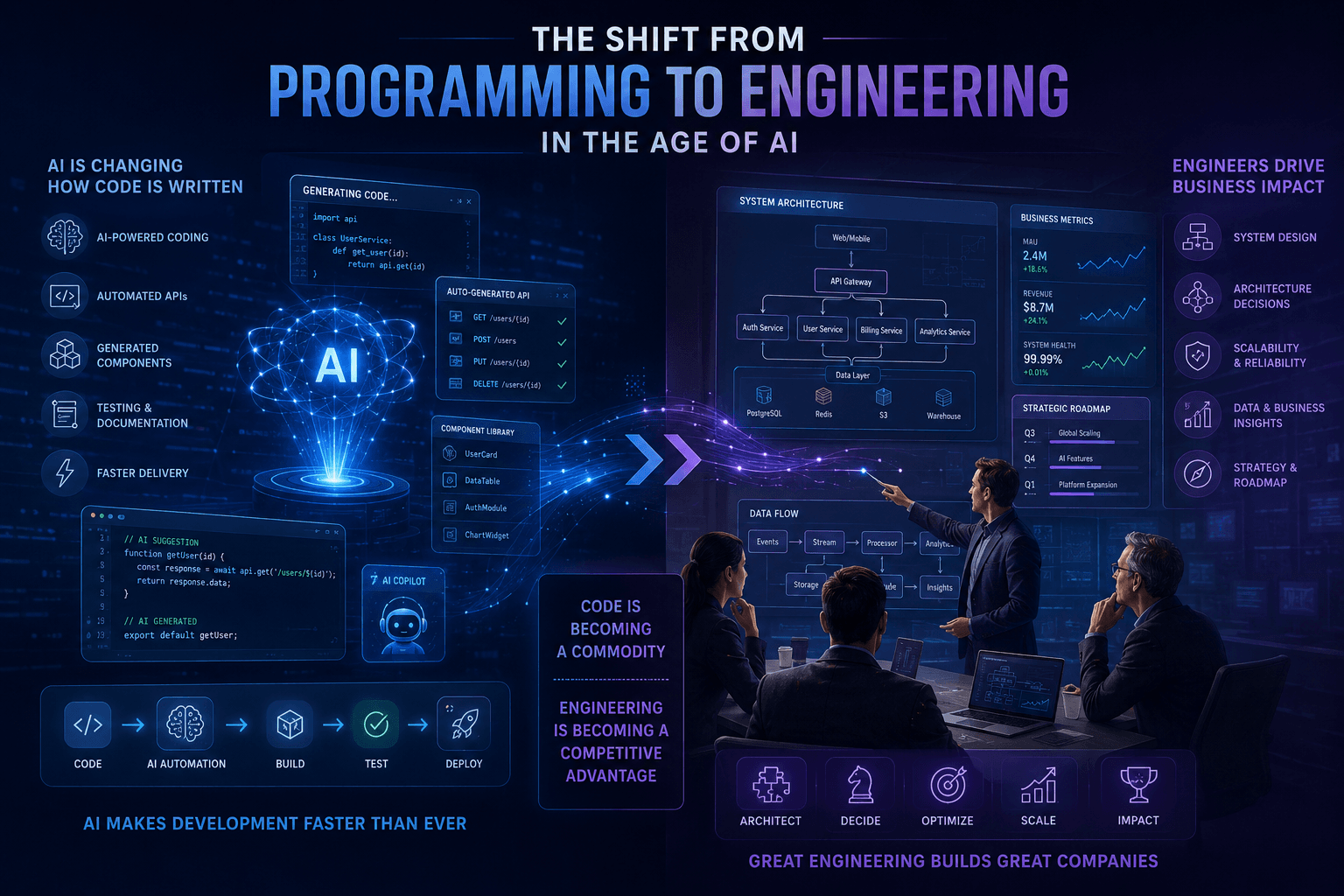
Artificial Intelligence is changing software development faster than any technological shift in recent history. Code generation tools can now produce APIs, write test cases, refactor components, and even create complete applications from natural language prompts.
Yet, despite these remarkable advances, one reality is becoming increasingly clear:
AI is automating programming faster than it is automating engineering.
For CTOs, founders, and technology leaders, understanding this distinction may become one of the most important strategic advantages of the next decade.
The organizations that recognize the difference between implementation and engineering judgment will build better products, reduce technical debt, and achieve sustainable digital transformation. Those that do not may find themselves shipping software faster but creating larger problems in the process.
Programming vs Engineering: Understanding the Difference
Programming and engineering have often been used interchangeably. In the AI era, they are becoming fundamentally different disciplines.
Programming is implementation
Programming focuses on:
- Writing code
- Building features
- Implementing requirements
- Translating specifications into software
- Fixing bugs and improving efficiency
AI tools are becoming exceptionally good at these tasks.
Modern AI development platforms can generate thousands of lines of code in minutes. Boilerplate implementation is increasingly becoming a commodity.
Engineering is decision-making
Engineering involves:
- Defining the right problems
- Designing scalable architectures
- Managing trade-offs
- Evaluating risks
- Understanding business impact
- Ensuring long-term maintainability
- Aligning technology decisions with organizational goals
These activities require context, judgment, and experience.
AI can assist engineering processes, but it cannot fully replace human engineering reasoning because engineering decisions are deeply tied to business strategy, organizational constraints, and uncertainty.
AI Is Compressing Implementation
A task that once required weeks of development can now be completed in days or even hours.
Examples include:
- Generating CRUD applications
- Creating integration layers
- Producing unit tests
- Migrating frameworks
- Building dashboards and prototypes
This compression is dramatically increasing productivity across software teams.
However, faster implementation creates a new challenge:
Bad decisions can now be implemented faster than ever before.
Organizations no longer suffer from lack of coding speed. They increasingly suffer from lack of engineering clarity.
This shift is making software engineering expertise more valuable, not less.
The Rise of Engineering Judgment in the AI Era
As implementation becomes cheaper, engineering decisions become more expensive.
Technology leaders now need to answer questions such as:
Should we build or buy?
AI can help create custom software quickly, but that does not automatically make building the correct choice.
What architecture will remain scalable?
Short-term gains can lead to long-term technical debt if engineering decisions are rushed.
Which systems should be modernized first?
Prioritization is becoming a critical leadership capability in digital transformation initiatives.
Where should AI be introduced?
Not every workflow benefits from AI implementation. Identifying high-value use cases requires engineering and business understanding.
This is where experienced engineering teams deliver value beyond code generation.
Organizations increasingly seek partners capable of providing strategic guidance alongside implementation through specialized AI engineering services that align technology investments with measurable business outcomes.
Why Engineering Matters More for Digital Transformation
Digital transformation initiatives often fail not because of poor coding but because of poor decisions.
Common reasons include:
- Misaligned business objectives
- Inflexible architectures
- Over-engineering
- Underestimating integration complexity
- Ignoring change management
- Creating unsustainable technical debt
AI accelerates delivery, but it also amplifies mistakes.
A poorly designed platform can now be built in weeks instead of months.
This makes engineering governance increasingly important.
Companies pursuing enterprise transformation need partners who understand both technology execution and business impact through comprehensive digital transformation services.
The New Competitive Advantage: Systems Thinking
Engineering is fundamentally about systems thinking.
Modern businesses are complex ecosystems involving:
- Customers
- Employees
- Data platforms
- Legacy systems
- Compliance requirements
- Security constraints
- Third-party integrations
- AI capabilities
A single architectural decision can impact every layer of the organization.
AI can generate code, but it cannot fully understand organizational politics, future business strategy, or market dynamics.
Engineering leaders who combine technical depth with business understanding will become increasingly valuable.
The future belongs not to organizations that simply write code faster, but to those that make better decisions faster.
AI Will Create More Software Than Ever Before
One unintended consequence of AI-driven development is software proliferation.
As barriers to implementation decrease, organizations will create:
- More applications
- More integrations
- More automation workflows
- More internal tools
- More AI agents
This explosion creates a significant challenge:
Who will manage complexity?
The answer is engineering.
Engineering disciplines such as architecture governance, platform strategy, observability, security, and lifecycle management become even more critical in AI-enabled enterprises.
This is particularly important for organizations pursuing large-scale software modernization initiatives and adopting legacy application modernization services.
Real-World Use Cases
Use Case 1: AI-Powered Customer Support Platform
Programming Challenge:
Build chat interfaces and integrate LLM APIs.
Engineering Challenge:
- Define escalation workflows
- Ensure compliance
- Design fallback mechanisms
- Measure business impact
- Prevent hallucination risks
The coding component may represent only a small percentage of the total engineering effort.
Use Case 2: Legacy System Modernization
Programming Challenge:
Migrate codebases.
Engineering Challenge:
- Identify modernization priorities
- Evaluate migration risks
- Minimize operational disruptions
- Design future architecture
- Create phased transition plans
Engineering judgment determines whether modernization creates business value.
Use Case 3: AI Agents for Internal Operations
Programming Challenge:
Implement workflows and APIs.
Engineering Challenge:
- Define decision boundaries
- Establish governance models
- Ensure security
- Create observability mechanisms
- Align automation with business objectives
As AI agents become more autonomous, engineering oversight becomes increasingly important.
Why CTOs Should Rethink Talent Strategies
For years, organizations primarily hired for implementation capability.
The future demands something different.
Technology leaders should increasingly prioritize:
1. Architecture Thinking
Can teams make scalable decisions?
2. Business Understanding
Do engineers understand revenue, customers, and operational goals?
3. Problem Framing
Can teams identify the right problem before implementing solutions?
4. Systems Design
Can they manage complexity across multiple platforms?
5. AI Governance
Can they responsibly integrate AI into business-critical processes?
Coding capability remains important, but engineering capability is becoming the larger differentiator.
The Future of Software Development Is Engineering-Led
AI will continue to improve rapidly.
Implementation costs will continue to decline.
Code generation will become increasingly commoditized.
This does not eliminate software engineering. It elevates it.
Organizations that thrive in this new environment will:
- Build strategically instead of reactively
- Modernize systems intelligently
- Use AI where it creates measurable value
- Focus on business outcomes rather than output metrics
- Invest in engineering leadership and architectural excellence
Forward-looking companies are increasingly seeking partners that combine engineering expertise with execution capabilities through end-to-end product engineering services and custom AI solutions.
How Artinoid Helps Organizations Navigate This Shift
At Artinoid, we believe AI should amplify engineering excellence rather than replace it.
Our approach focuses on:
- AI-first product engineering
- Intelligent digital transformation strategies
- Legacy modernization initiatives
- Data-driven decision systems
- Scalable software architectures
- Responsible AI implementation
We help organizations move beyond simply building software faster.
We help them build the right software, for the right reasons, with the right engineering foundations.
Whether you are exploring AI adoption, modernizing legacy platforms, or creating new digital products, strategic engineering remains the key to long-term success.
Ready to transform your business with AI and engineering expertise? Explore Artinoid's AI engineering and digital transformation services to build scalable, future-ready solutions.
Frequently Asked Questions
Will AI replace software engineers?
AI is more likely to replace repetitive programming tasks than software engineering itself. Engineering activities such as architecture design, systems thinking, business alignment, and decision-making remain highly dependent on human expertise.
Why is engineering becoming more important with AI?
As implementation becomes easier, making the right technology decisions becomes increasingly valuable. Poor decisions can now be executed faster, making engineering judgment critical.
How does AI impact digital transformation initiatives?
AI accelerates development and automation, but successful digital transformation still requires strong engineering governance, modernization strategies, and scalable architectures.
What is the difference between software development and software engineering?
Software development focuses on building applications, while software engineering encompasses architecture, scalability, risk management, business alignment, and long-term maintainability.
How can businesses prepare for AI-driven software development?
Businesses should invest in engineering leadership, AI governance, modernization strategies, and partners that combine technical implementation with strategic decision-making.