The Lean Approach to AI Product Development: Build, Test, Iterate
Here's something most AI vendors won't tell you: according to the MIT NANDA State of AI in Business 2025 report (based on 150 executive interviews, 350 employee surveys, and analysis of 300 public AI deployments), 95% of generative AI pilots fail to deliver measurable impact on the P&L. RAND Corporation puts the broader AI project failure rate at over 80%, which is twice the failure rate of non-AI IT projects. And S&P Global's 2025 survey found that 42% of companies abandoned most of their AI initiatives this year, up from just 17% in 2024.
This isn't a technology problem. The models are getting better every quarter. The problem is how organizations build.
Most teams approach AI like a construction project: blueprint first, then build, then reveal. But AI doesn't work that way. Outputs are probabilistic. User needs shift. Data quality surprises you. What looked reasonable in a slide deck looks very different after six months of engineering and $400K in compute costs.
The lean approach to AI product development exists to solve exactly this. Instead of long, waterfall-style development cycles and massive upfront commitment, lean AI is about moving through tight loops: build the minimum, expose it to real users, learn fast, and only scale what's actually working.
This post explains how to do that, with real examples and without the usual platitudes.
Why So Many AI Projects Die Before Production
Before talking about solutions, it's worth being specific about what's actually going wrong.
The S&P Global data tells a sobering story: the average organization scraps 46% of its AI proof-of-concepts before they ever reach production. And McKinsey's 2025 AI survey found that organizations reporting significant financial returns are twice as likely to have redesigned their end-to-end workflows before selecting any modeling technique. Most teams do it backwards. They pick the model first, then try to make the workflow fit around it.
There are a few patterns that show up repeatedly in failed AI initiatives:
Misalignment between the problem and the solution
Teams often build AI for problems that didn't require AI, or they frame the problem in tech terms rather than business terms. RAND's analysis of AI project failures identifies this as the single most common root cause: stakeholders miscommunicate (or misunderstand) what problem actually needs to be solved.
Data problems that only surface late
Informatica's CDO Insights 2025 survey found that 43% of organizations cite data quality and readiness as their top obstacle to AI success. But most teams don't discover this until they're well into model development. The budget is mostly spent before the data problems are visible.
Building for a perfect v1
There's a tendency in enterprise AI to treat the first deployment like a product launch: polished, complete, thoroughly tested before anyone outside the team sees it. This is exactly the wrong instinct. The feedback you need to build the right thing can only come from real users in real conditions, and the longer you wait to get it, the more expensive your mistakes become.
Premature scaling
Research consistently shows that premature scaling is responsible for the failure of over 70% of startups, and the same dynamic kills AI initiatives inside larger organizations. You can't scale your way out of a flawed foundation.
What Lean AI Product Development Actually Means
The lean startup methodology was formalized by Eric Ries in 2011, building on Steve Blank's customer development work and Toyota's production system philosophy. Its core insight is that startups don't fail from lack of execution, but from executing the wrong thing. That turns out to apply directly to AI products.
Lean AI extends this with one important addition: AI systems require ongoing learning loops even after launch. A traditional software product can be "done." A machine learning model never is, because its performance depends on data it hasn't seen yet, in contexts that keep changing.
The practical loop looks like this:
- Define a specific, measurable business problem. Not "use AI to improve customer experience," but "reduce first-contact resolution time for Tier 1 support tickets by 20%."
- Build the minimum version that could produce evidence. This is your AI MVP.
- Expose it to real users under real conditions.
- Measure what actually happens, not what you predicted.
- Use what you learned to decide what to build next.
- Repeat.
The key word in step 4 is "actually." Vanity metrics (model accuracy on a test set, number of API calls, time-on-page) are seductive because they're easy to collect and they usually look good. The metrics that matter are the ones tied to the original business problem: resolution time, conversion rate, cost per unit, error rate in production.
How to Build an AI MVP (With Real Examples)
The concept of the minimum viable product gets misunderstood constantly in both startup and enterprise contexts. An AI MVP is not a prototype, not a demo, and not a proof-of-concept that lives inside a Jupyter notebook. It's the simplest version of your system that real users can interact with and that produces real feedback.
Some of the most successful companies in the world validated ideas this way before they had anything close to a finished product:
Dropbox didn't build cloud sync infrastructure before validating demand. Instead, Drew Houston and Arash Ferdowsi posted an explainer video showing how the product would work. The video went viral on Hacker News and generated tens of thousands of email signups overnight. They had their validation signal before writing most of the actual code. Dropbox now has over 500 million registered users.
Netflix's recommendation system, which now drives over 80% of viewer engagement on the platform, didn't start as a sophisticated deep learning model. It evolved from simpler systems through years of iterative improvement driven by real viewing data from real subscribers. The same approach: start with something that works, measure it, make it better.
Amazon's product recommendation engine, which generates approximately 35% of total sales, was built through continuous experimentation and A/B testing over years, not a single big-bang deployment.
These aren't coincidences. They're the same pattern: start with a problem, build the smallest thing that could provide signal, measure it honestly, iterate.
For AI specifically, your MVP might be (and if you need help scoping or building one, this is exactly what AI engineering teams do best — or you can start with a free 1-week POC to validate the smallest version of your idea before committing budget):
- A rule-based system that handles the most common case while you collect data for a future model (many successful "AI" products started this way)
- A narrow classifier trained on whatever data you have, deployed to a small user segment
- A human-in-the-loop system where the model makes suggestions but humans make final decisions, giving you quality signal before you automate
- A single-feature AI tool that solves one specific problem well, rather than a multi-modal platform that does many things mediocrely
The Startup Genome Report found that startups using a validated learning approach have a 27% higher success rate than those that don't. That gap almost certainly widens for AI products, where the cost of building the wrong thing is higher.
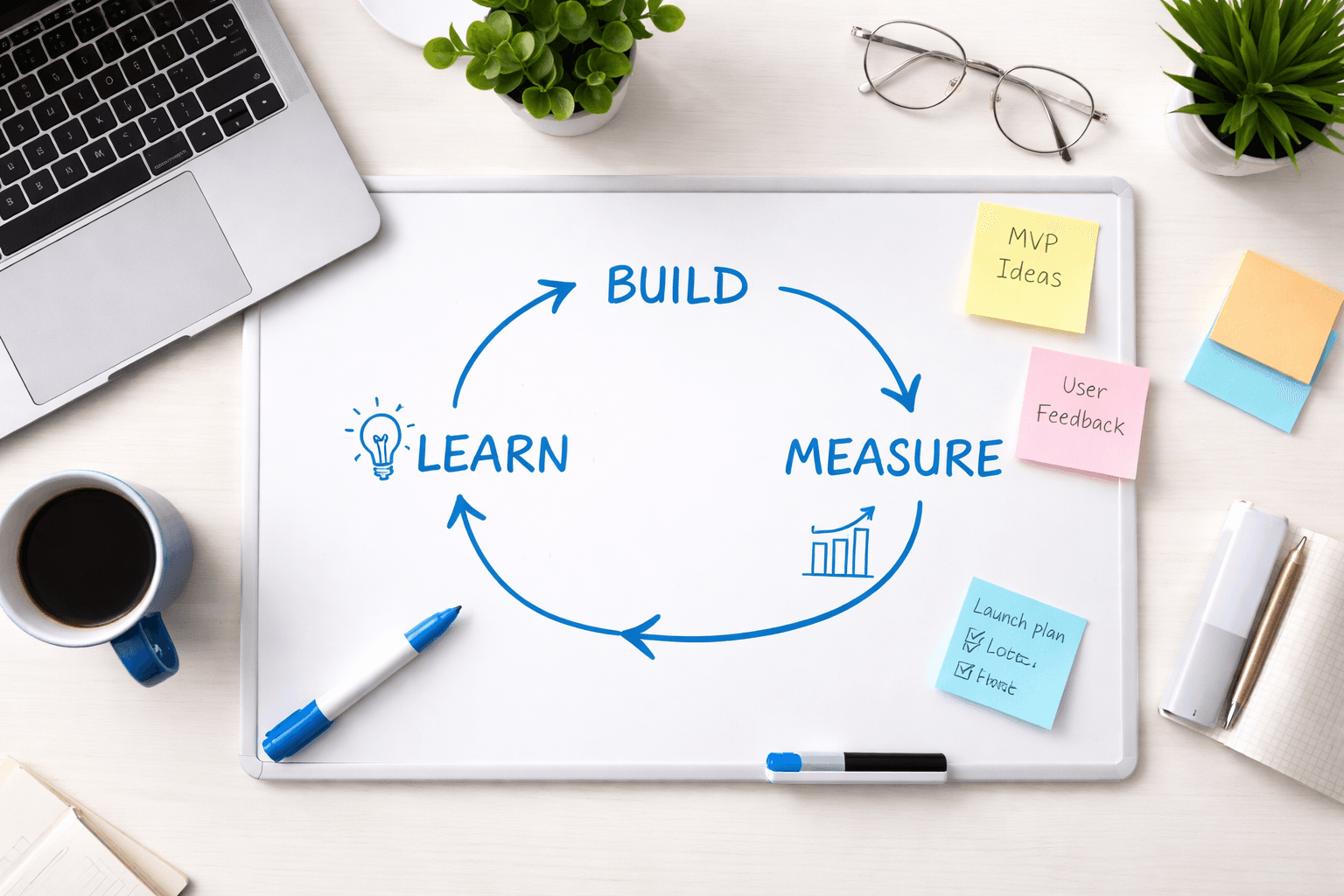
The Build-Measure-Learn Loop for AI
In AI product development, the build-measure-learn loop has some specific characteristics worth understanding.
Building
The first build should be driven by one question: what's the fastest way to get this in front of real users? Not: what's the cleanest architecture, what's the most scalable infrastructure, what's the most sophisticated model.
This means being willing to do things manually in the beginning. Etsy, Airbnb, and Zappos all started by doing things manually that they later automated. In AI, this might mean having a human review every model output before it reaches the user. Not as a permanent solution, but as a way to validate the workflow while collecting training data.
Modular architecture matters here, but not because you need to build all the modules now. It matters because it means you can swap components later without rebuilding everything. Use API boundaries. Keep your data pipeline separate from your model logic.
Measuring
This is where most teams go wrong. Measurement is not model evaluation. You can have a model with 94% accuracy that produces no business value, and a model with 78% accuracy that your users love.
Measure business outcomes: Did the support ticket get resolved faster? Did the customer convert? Did the clinician catch the anomaly that a human might have missed?
Also measure failure modes: where does the model confidently give wrong answers? What percentage of users are overriding its recommendations? These signals tell you where to invest next.
Learning
Learning means being willing to change your assumptions. The research on lean AI at MIT found that combining discovery-oriented AI with rapid prototyping reduces first-release product development time by approximately 15%. That number only matters if your team is actually using what it learns to change direction.
The most dangerous outcome of a build-measure loop isn't learning that your hypothesis was wrong. It's learning that it was wrong and building more of the same thing anyway.
The MIT Finding That Changes How You Should Think About This
One detail from the MIT NANDA report deserves more attention than it usually gets: vendor-led AI implementations succeed approximately 67% of the time, while internal builds succeed only about 33% of the time.
This isn't an advertisement for outsourcing. It's a signal about specialization and feedback loops. External teams that have built and shipped multiple AI systems in a specific domain carry pattern recognition that internal teams building their first system don't have. They've seen the data quality problems, the deployment surprises, the user behavior that didn't match expectations. They've already run the lean loop a few times.
The implication for organizations: if you're building your first AI product in a domain, seriously consider partnering with people who have shipped in that domain before. The 2x success rate is a real signal.
Common Failure Modes (That Lean Catches Early)
The Data Assumption Problem
Most teams assume their data is good enough. In production, it rarely is. Quest's 2024 State of Data Intelligence Report found that 37% of organizations cite data quality as their top obstacle to strategic data use. The lean approach surfaces this in week 2, not month 8.
Practical fix: before training anything, manually inspect 200–300 samples of your actual production data. Not a curated subset. Production data. You will find things that change what you're building.
The Proxy Metric Trap
Teams optimize what's easy to measure, not what actually matters. Accuracy on a held-out test set. Click-through rate. Model latency. These can all be excellent and your product can still fail.
Practical fix: define your success metric in business terms before you write the first line of code. Write it down. Make it the thing you check before every sprint.
The Stakeholder Surprise
AI teams often work in isolation and present finished systems to business stakeholders who have different expectations. The gap between what was built and what was needed only becomes visible late, when it's expensive to fix.
Practical fix: involve a real business stakeholder (someone who will actually use the output or be accountable for the outcome) in your iteration cycle from week one.
What Lean AI Looks Like in Practice: A Support Automation Example
Imagine you're building an AI-powered support ticket routing and response system. Here's what the lean path looks like vs. the common mistake:
Common mistake: Spend 3 months building a multi-class classifier, a custom NLP pipeline, and an integration with your ticketing system. Demo it to leadership. Find out the top 3 ticket categories they care about weren't in your training data. Go back to square one.
Lean path:
Week 1–2: Pull 6 months of resolved tickets. Manually categorize 500 of them. You now know what your actual distribution looks like.
Week 3–4: Build a rule-based router for the top 5 ticket types (which probably represent 60-70% of volume). Deploy it to a small segment of incoming tickets alongside your normal process.
Week 5–6: Measure resolution time, override rate (how often agents change the routing), and customer satisfaction scores for that segment vs. the control group.
Week 7–8: If the routing is working, train a classifier on your labeled dataset to expand coverage. If the resolution time isn't improving, find out why before building more.
You've de-risked the project in 8 weeks instead of 6 months.
Scaling What Works: Moving From MVP to Production
The lean approach isn't a permanent state. Once you have evidence that something is working (genuine business impact, sustained user engagement, favorable unit economics) you need to scale it properly.
This is where architecture decisions that seemed premature in the MVP phase start to matter. Cloud-native infrastructure lets you scale compute without rebuilding. API-first design lets you swap model providers or versions without touching application logic. Teams that invest in proper product engineering at this stage avoid the costly rewrite that haunts most AI products that were built to demo, not to scale. Observability tooling lets you watch your model's behavior in production and catch drift before it becomes a problem.
The thing to avoid is treating the MVP architecture as permanent. Many teams skip the "now let's rebuild this properly" phase because the MVP is working well enough. This creates technical debt that eventually makes iteration slower, not faster — which defeats the whole point.
McKinsey's analysis is instructive here: the organizations getting the best returns from AI are those that "redesigned end-to-end workflows" — not just layered AI on top of existing processes. Scaling lean AI means scaling the workflow, not just the model.
FAQs
How is lean AI development different from agile?
Agile focuses on iterative software delivery. Lean AI includes that but adds an explicit emphasis on validating whether you're solving the right problem before optimizing how well you're solving it. In practice, lean AI teams typically run shorter cycles and are more willing to scrap features based on user data.
What if we don't have enough data to build an MVP?
Start with rule-based systems or human-in-the-loop workflows to generate the labeled data you need. Collecting good training data is a product decision, not just an engineering task.
Is lean AI suitable for regulated industries like healthcare or finance?
Yes — but the validation loops need to account for compliance checkpoints. Lean doesn't mean skipping regulatory requirements; it means not building more than necessary before you've validated the core value proposition.
How long does a lean AI MVP typically take?
Meaningful results in 4–8 weeks is a reasonable expectation for a scoped problem with accessible data. If it's taking longer to get something in front of real users, the scope is too large.
When should you stop iterating and call the product done?
You don't — but the nature of iteration changes. Early iteration is about discovering whether you're building the right thing. Later iteration is about optimizing a thing that's already delivering value. The transition happens when you have stable, positive business metrics.
The Honest Summary
The 95% failure rate for generative AI pilots isn't inevitable. It's the result of applying the wrong development model to a technology that requires continuous learning to succeed.
The companies winning with AI — Netflix, Amazon, the specialist vendors MIT found succeeding at 67% — share a common approach: they define specific business problems, build small, measure honestly, and iterate faster than their assumptions can mislead them.
That's the lean approach. It's not glamorous. It doesn't require the most advanced model or the largest data set. It requires discipline about what you're building and why, and the willingness to change based on what you learn.
The good news is that this is learnable. The better news is that most of your competitors haven't learned it yet.
If you want the smallest possible first iteration of your AI idea — a working prototype on real or representative data, in five working days, at no cost — that is exactly what our free 1-week AI POC is built for. Five days is short enough to be a true lean experiment, and the source code is yours regardless of whether we work together afterwards.
Sources: MIT NANDA "The GenAI Divide: State of AI in Business 2025"; RAND Corporation "The Root Causes of Failure for Artificial Intelligence Projects" (2024); S&P Global Market Intelligence AI survey 2025; McKinsey 2025 AI Survey; Informatica CDO Insights 2025; Quest "State of Data Intelligence Report" 2024; Startup Genome Report; Fortune coverage of MIT NANDA findings.